Reigate History
Reigate & Redhill DVDs and associated local history

St. Mary's, Reigate
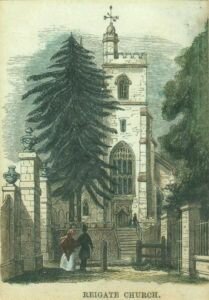
Reigate Parish Church
|
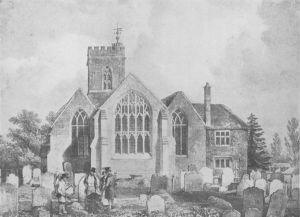
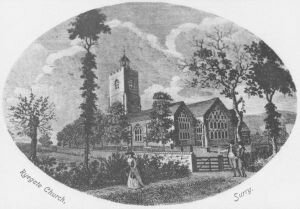
In the Beginning - 1066 and all that We do not know exactly when St Mary's was founded but it is reasonable to assume that there was a church in Reigate or Cherchefelle as this area was then known - meaning church field - at the time of the Norman Conquest. It is quite possible it dates back even further than this. The first written record of St Mary's was in the 1160s when the church, "Crechesfeld" - church field or church on a hill, was presented to the Augustinian Priory of St Mary Overie - now known as Southwark Cathedral, by Hamlin & Isabel de Warenne. We can imagine the monks walking from the Priory to church (Monks Walk and Church Walk) to mass before they built their own church and saved themselves the climb up the hill. This is not the church's only link with the Priory as the last four Priors were also vicars of Crechesfeld (St Mary's). The last Prior to be vicar was John Lymden in 1532 shortly before the Reformation and the dissolution of the monasteries. Originally the church would only have consisted of what is now is the central nave and possibly a central tower. Pre Reformation and Catholicism
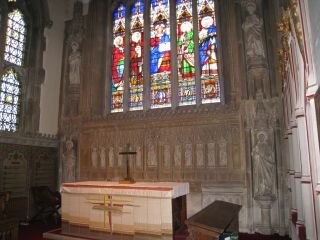
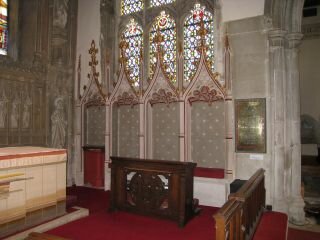
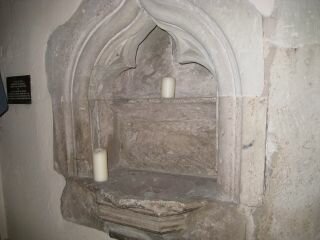
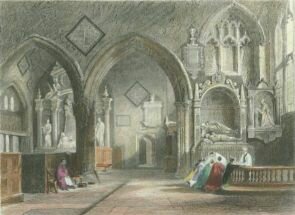
Reredos and Sedila in St Mary's Church, Reigate Firstly the reredos and sedilia surrounding the high altar in the sanctuary, this has survived as it was hidden by wood and plaster for hundreds of years and was only uncovered during Victorian renovations in 1845. The saints were absent but were replaced in the 20th century, but you can still see the intricate carving around the niches and canopies. When it was first unveiled, evidence of colours and gilt were visible, as often seen in catholic churches, and an attempt to reproduce these colours was made in Victorian times. Hidden away in the south west corner is a piscina (a trough used for the draining of water after the priest washed his hands before consecrating the bread and wine for communion), redundant for hundreds of years.
Piscina, St Mary's Church, Reigate The rood screen is also redolent of the church's catholic past and would originally have been surmounted with a great rood (A representation of Christ on the Cross, flanked by the Virgin Mary and St John) - the screen serving to separate the congregation from the priest and the high altar. The current screen is thought to date back to the Victorian restorations and most probably incorporates parts of the original medieval screen. The vestry and the room above, which houses the Cranston Library, were built in 1513, although the library was not established until 1701.
As a result of all these extensions St Mary's became one of the largest churches in Surrey.
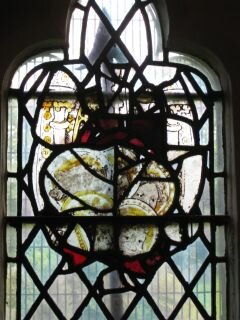
In 1541 The Priory was given by the King to Lord William Howard and St Mary's catholic past was assigned to the history books. For 300 hundred years the building altered little. However, Thomas Glynn - described as a madman and glasier - did his bit to bring about change. In 1661 he smashed and tore out the windows. [remnants of the medieval glass were gathered up and reset, later in a window of the Cranston library]. For this act of vandalism he was fined only 12d (5p).
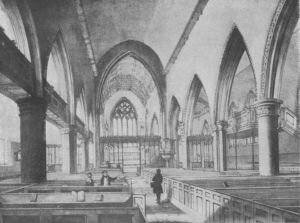
Remnants of Medieval Glass, reset in a higgledy piggeldy fashion in a window in the Cranston Library As church attendance became compulsory the church would have been packed. Families of the nobility and who considered themselves a cut above would have rented their own pews for which Evelyn Alston, Bart. Esq paid 1 guinea and a fat turkey per year. John Parsons came to Reigate Priory in 1681 and donated the impressive chandelier that can still be seen hanging by the tower. 'RESTORATION' (18th and 19th centuries) In the 18th century some galleries were added to the church. A gallery was erected at the back of the church to house a choir and a local band of musicians. The members of the choir took their duties very seriously and signed an agreement to sing at all Sunday morning and afternoon services - "to sing Psalms and any Item for the better improvement and making ourselves fitt for singing". But in 1832 to an organ was placed at the west end and in 1850 the gallery was removed. In 1700 the south aisle was "cumbered" with another gallery erected for Sir John Parsons of Reigate Priory to house his wife, children and very large family. This remained for 150 years and used by subsequent owners of the Priory until it was removed in about 1845. To complete the trio of galleries another gallery was added to the north aisle in 1818 and accommodated 11 families. The galleries were removed during the Victorian restorations.
Some rather alarming 'improvements' took place in 1820. All the external buttresses, save 2, were removed and all the tie beams and king posts of the great centre roof were removed. Not surprisingly by 1828 the roof was in danger of collapsing! To make amends for this folly iron tie rods were inserted in the nave and chancel (and remain to this day) and the aisle walls were shored up with makeshift buttresses. In 1824 the tower was extensively repaired and the turret on the tower was replaced with a wooden belfry. However, by 1873 the nave and tower were considered unsafe and were taken down and rebuilt, apparently with no deviation from the original designs. It was necessary to cover the tower and much of the building with Doulting stone, the church was originally of Reigate stone. It was at this time that the gallery in the north aisle was removed and the height of the north aisle reduced to its original height.
St. Mary's unknown date In 1845 Mr Henry Woodyer of Guildford was commissioned to 'improve' the church in the then fashionable Gothic style. Many of the windows were replaced at this time. The current window in the south chapel was replaced after it was destroyed during the second world war. Up until 1828 the east windows had contained pieces of 15th century glass, the de Warenne shield was reset in the Cranston library window and pieces of medieval glass were also set in a window in the library. The nave was reseated at this time. The reredos and sedilia were uncovered and the rood screen was restored.
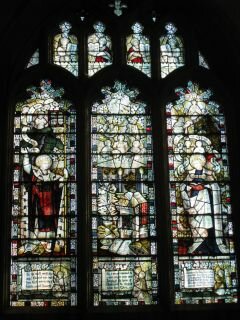
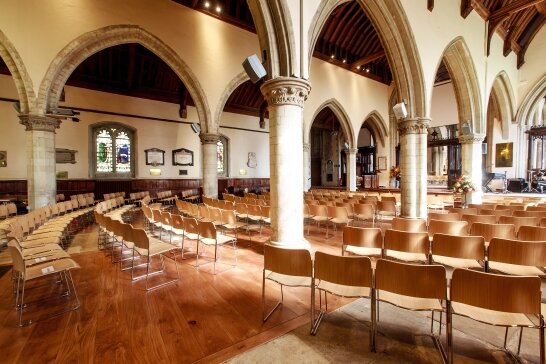
A Victorian South Aisle Window by C E Kempe 20th Century to the Present Day The organ chamber was added in 1908. In the 1980s the chancel was leveled and the choir pews removed under which was found a stick of dynamite - presumably dating back to the 2nd World War. A Dais was added in front of the screen. The C21 has seen the removal of the pews from the main section of the church and the laying of a wooden floor.
St. Mary's after the reordering in 2012
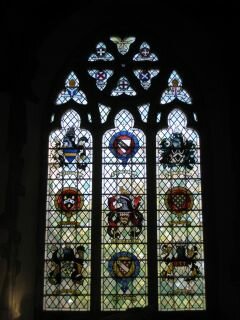
This window in the South Chancel by Joan Howson. It was replaced in 1949 after it had been blown out in a bombing raid during the 2nd World War. It contains the coats of arms of local families.
Bibliography
Both these books have chapters devoted to the Parish Church plus illustrations. The Handbook to Reigate has some particularly charming pictures. They are both old fashioned but remain the only books with a comprehensive history of the area. The Handbook also includes Gatton, Merstham, Chipstead, Leigh and Betchworth. Definitely worth adding to your book collection if you are interested in local history.
|
|
|
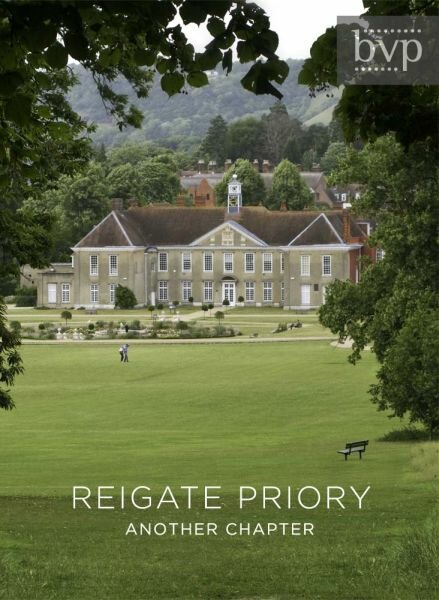
BVP have released a DVD about Reigate Priory, "Reigate Priory - Another Chapter" which includes some of the history of St. Mary's as the Priory and St. Mary's have historical links. |