Reigate History
Reigate & Redhill DVDs and associated local history

Life in Reigate During the 1920s & 30s
by Carolyn Burnley
|
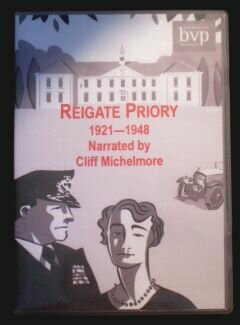
Reigate between the two world wars was a very different place to today. The beginning of the 1920s was marked by the "Great Sale of Reigate" in 1921 following the death of Lady Henry Somerset. The Somers family had owned Reigate Priory and much of Reigate and the surrounding area for over 100 years. Up until this point many people and businesses had been tenants in the Manor of Reigate but in 1921 were given the opportunity to buy their properties. At this time the Priory was sold to the celebrated Admiral of the first world war, Earl Beatty and his wife Countess Beatty, for £35,000. Along with the buildings their grounds extended up to the wooded hills of the Priory, in those days known as Reigate Park. The park was purchased in 1920 by Randal Vogan and given to the people of Reigate. The rest of "the Priory" as we know it today was privately owned by the Beatty's and not open to the public (unless you were foolhardy enough to climb the fence for a little scrumping!). (For more information on this era and to see a clip online of the documentary "Reigate Priory 1921 - 1948" click here.)
The Priory was not the Beatty's only residence. They used it for weekend parties and entertaining, among their guests were many dignitaries including royalty and Winston Churchill. The decorations in the house were lush and they had a large staff to run the house and gardens. The grounds were beautifully kept by a team of gardeners and the area now occupied by football pitches would have been grazed by their horses. The large area to the side was an orchard and Safeways was the kitchen garden. On occasions Lady Beatty held events to which some local people would have been invited, for example she held horticultural shows, which were said to rival Chelsea, and Conservative fetes. In the winter you may have been lucky enough to be invited to skate on the pond but most people of Reigate only caught glimpses of this life over the perimeter fence.
Reigate Heath 1928 Meanwhile the ordinary folk of Reigate got on with their lives. Perhaps the local families and shop owners were of more consequence than the Beatty's locked away at the Priory. There were several family businesses which had run for generations and were well known by the populace. One enduring example is the Knight family who, until recently, still owned Knights in Bell Street, Reigate. Other examples, sadly no longer there (although some of their descendants are still in the area), are Matthews the greengrocers and flower shop in Reigate High Street, Tamplin & Makovski's for domestic heating and the modern-day equivalent of the hifi, Northovers the cabinet makers and funeral directors, La Trobes, Martin Dunsford and Knappers the coffee shop on the corner of Park Lane East and many more. We also had our local dignitaries who were well known to residents, among the very wealthy were Sir Jeremiah Colman (of Colman's mustard) at Gatton Park and Arthur & Joseph Rank (who owned the film company and millers respectively). Both families donated public buildings to the local people. Other prominent community members were Aldermen Temple-Newell, Woodroffe and Colonel Spranger from Castle Keep in the Castle Grounds. [A comprehensive list of mayors can be found on Alan Moore's website details at the end of this article.] But although these people were well known, most people were busy getting on with their own lives. Although many properties were bought in the Great Sale of Reigate in 1921 many people remained tenants to private landlords, this is probably true of many Victorian houses now privately owned in Reigate. Most children left school at the age of 14 unless they were lucky enough to get a scholarship (as it was called then) to Reigate County School for Girls (now the 6th Form College) or Reigate Grammar School for boys (now independently run) and even then their parents may not have chosen to send them there because of the expensive uniforms or because they wanted their children to go out to work. Children would have attended Holmesdale School (then in Holmesdale Road, now in Alma Road), St Marks School also in Holmesdale Road (now demolished), the Parish on the corner of Hardwicke Road (now a private residence, the school having moved to Blackborough Road) or the National School in London Road. There were also some independent schools including the Kerri school which has recently been the subject of several articles in the Surrey Mirror. After leaving school at the age of 14 you would most probably have been employed locally and possibly have worked for one of the shops mentioned earlier, local businesses or have gone into service for one of the local gentry.
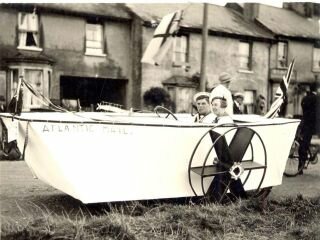
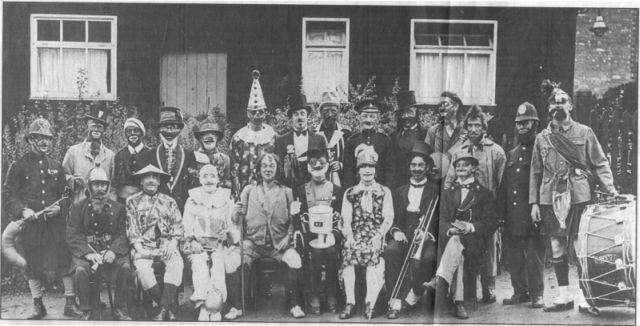
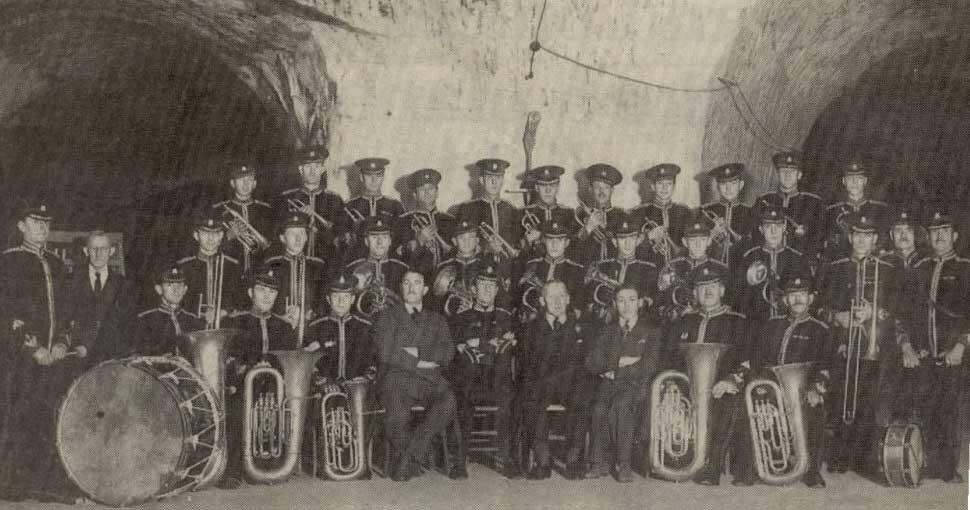
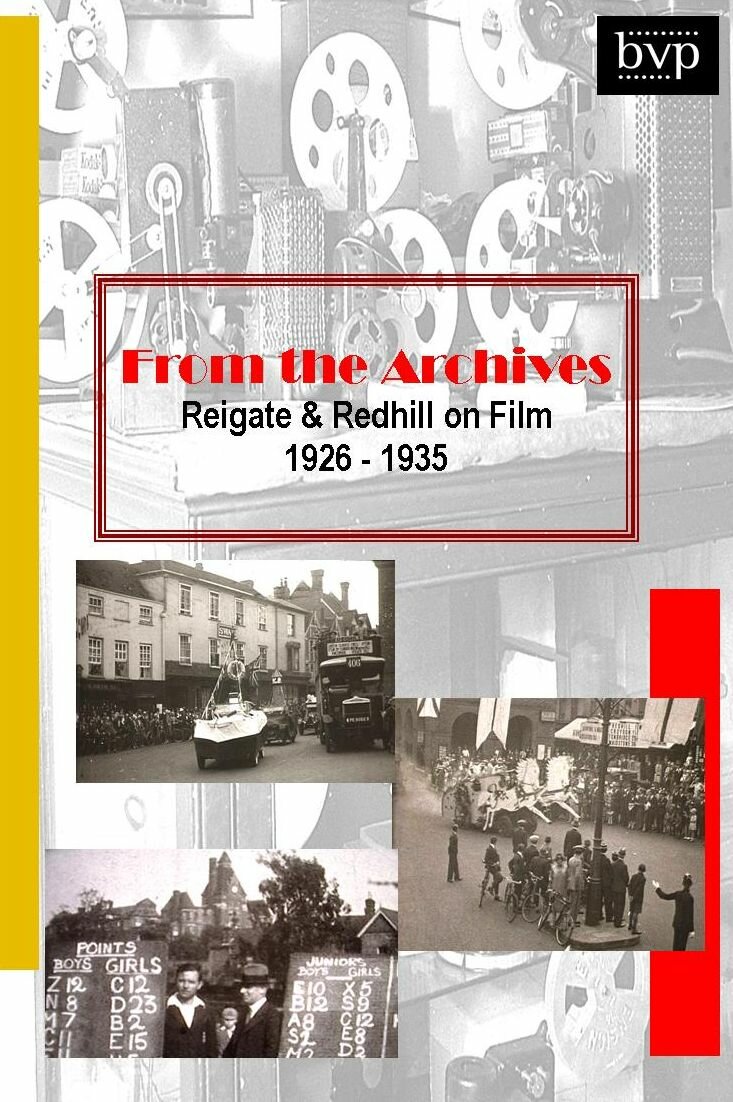
A group of 'Carnivalists' circa 1934 As far as entertainment was concerned most of it would have been of your own making, but there were also several public events. The most notable were the annual carnivals (see a clip online and get info about a DVD with archive film footage here) which seemed to involve everybody in some way. Some of the floats would take months to construct and many people would take great care preparing their costumes. There were also other pageants which were prepared with just as much attention to detail. Edwards Fair used to come to the area fairly regularly and dances were also popular. At this time Reigate had an excellent band, Reigate Town Silver Band, who performed on Saturday nights in Market Square (by the Old Town Hall), their rehearsals were held in one of the caves off Tunnel Road. In the 1920s Reigate had one cinema, the Hippodrome in Bell Street (now demolished) which would have started off by showing silent movies, concerts were also held here. Later in the 1930s Reigate also gained the Majestic Cinema in Bancroft Road. Sport was also popular and there were several sporting clubs. Other clubs were also well attended such as the WI, Mothers' Union and scouting and guiding troops.
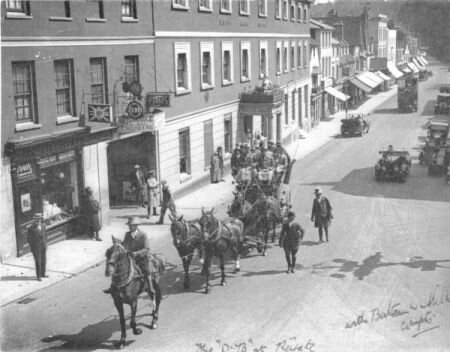
Reigate Silver Band circa 1935 in the Tunnel Caves As well as a healthy selection of shops in the centre of Reigate, there were also many more small shops in residential roads than today. It was quite normal to have a butchers, bakers and greengrocers in or near your road of residence, for example Doods Road, Nutley Lane, Lesbourne Road and Holmesdale Road - unfortunately most of these shops have now gone with the exception of the Lesbourne and Holmesdale Road areas which have survived in some form. This is also true of areas such as South Park and Meadvale which were then considered separate villages and had their own shopping facilities. Most people did not own cars and would travel by bus, train, bicycle or shanks's pony. East Surrey Traction Company ran buses out of Bell Street and, in addition to the regular bus services, also ran trips to London and the coast. Many businesses including milkmen still used a horse and cart or bicycles for smaller loads (such as ice cream). The Reigate Borough Police Force was responsible for law and order. No pander cars then, it was the beat or horseback. Chief Constable Beacher is still remembered to this day for leading the carnivals on his white horse. Everyone knew the name of their local bobby and, if you were unfortunate, they knew your name too. However, as all policemen had to be at least 6ft tall, you stood a good chance of spotting them before they saw you. The Fire Brigade was voluntary at this time and was run by a group of retained firemen. The fire station was in Castlefield Road. The 1930s saw several changes to the centre of Reigate. It brought the much lamented demolition of the White Hart in Bell Street - a large coaching inn that had been patronised by royalty - and the Swan Inn opposite the Old Town Hall, which had dated back to the 15th century. Up until this time Church Street had been very narrow as it was bordered on the south side by the garden wall of the White Hart. The sale of the land belonging to the White Hart made it possible to widen Church Street and to build Bancroft Road and the Majestic Cinema.
Earl Beatty died in 1936 (the Countess having died four years earlier) and the Priory passed to his second son, Hon. Peter Beatty. Peter Beatty made few alterations to the Priory but did build the swimming pool (now a children's paddling pool) where it is rumoured royalty were among those to enjoy skinny dipping. He also built the thatched stables near Park Lane East where he stabled his 1938 Derby winner, Bois Roussel. At the outbreak of war in 1939 he leased the Priory to Joseph Rank Ltd, Millers.
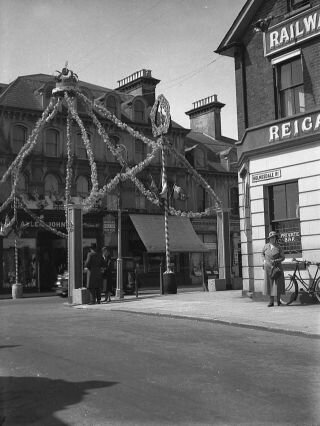
Decorations for the Jubilee of King George V, 1935 Although Reigate did have its larger houses which were occupied by professionals who led a more cosmopolitan life, most people's lives were very much centred round Reigate. It was not uncommon to find several generations of the same family all living in one street. There was no M25, no really large offices and little private transport which meant people's lives were very much contained within the area in which they lived. ©Carolyn Burnley 2003 Reigate History part of BVP can transfer your old camcorder tapes and cine film to DVD. Call for details. The information in this article is largely based on information gathered when researching these two DVDs. Click on the pictures below to view clips from these DVDs and purchase online.
|