|
"Towards the end of August 1940, the Battle of Britain was well under way, and we could clearly see the German Bombers as they passed overhead to make their daylight raids. More frightening from our point of view were the accompanying dive bombers and fighter planes who were supposed to shoot down our fighters and destroy the airfields.
London itself was encircled by a ring of enormous and ugly Barrage Balloons, which were also used to protect strategic targets such as docks and military installations. Living in close proximity to Redhill Aerodrome, we were often subjected to the bad aim of the Dive Bombers and the fallout from hundreds of "Dogfights" and less frequently vicious attacks from "Stukas" who would scream down to shoot-up local housing estates, including Prince Albert Square.
I still feel a twinge of shame when I recall the many, many "Dogfights" we watched from the comparative safety of our gardens. Our behaviour as young boys, was similar to those who now watch football matches. Sadly, as we willed our team of Spitfires and Hurricanes decorated with RAF Circles to win, we gave no thought to the dreadful consequences of success - or failure. Whenever one of the Messerschmitts or Junkers bearing their black crosses and swastikas, was shot down, we would all cheer deliriously, or moan in an equally moronic fashion if it was one of ours who lost this lethal game. Partly due to our immature lack of imagination, and partly due to the overwhelming amount of propaganda everyone was subjected to, we gave little thought to the horrendous results of the games being played above us. If, as a Spitfire or Hurricane was spiralling towards the ground, we saw the pilot's chute open, a cheer of relief would be heard. On the other hand, if it was a German airman slowly descending, we would all rush for our bikes and speed off, hoping to watch the Boche being arrested as we shouted insults at him and tried to snatch a souvenir from the wreck of his plane.
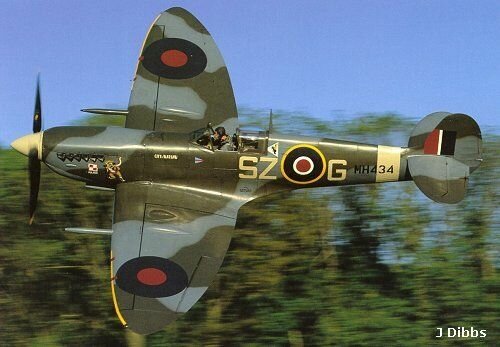
Photograph courtesy of the Aircraft Restoration Company
On one occasion during a school holiday, the Co-op Milkman was making deliveries from his horse-drawn float when the spiteful pilot of a "Stuka" dive Bomber decided to shoot-up "The Square". The noise these planes made as they dived down was expressly designed to terrify, but when they eventually flattened out and roared along the road at rooftop height, spitting out bullets which ricocheted off the road like red-hot missiles, it was petrifying. Mum shouted to the Milkman and held the front door open for him to take cover. He ran up to the doorway, paused, then immediately ran back again in spite of the bullets, to release his horse from the shafts and allow it to gallop off with eyes rolling in fear. The Milkman told us, he just had to give his pal of many years a sporting chance.
Talking of horses, I was particularly fond of the Greengrocer's horse, which I used to visit sometimes at the Greengrocer's home in Earlswood Road, Earlswood. The horse was stabled in a tiny yard at the rear of Airey's, the butchers where Dad worked part-time at busy seasons preparing pigs and fowl for the shop. Whenever the air-raid siren sounded, the horse would be taken into the house to shelter under the stairs with the greengrocer and his family.
By the end of October 1940, Hitler had lost his chance to end hostilities quickly and the "Battle of Britain" was over, yet the war had yet to be won."
©Alex Moon
This article has been reproduced with the kind permission of Alex Moon. During the second world war he was living in Albert Square, Lower Earlswood on the outskirts of Redhill, Surrey
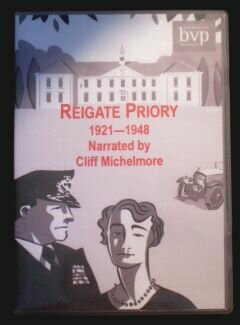
This era is included in the DVD produced by BVP, Reigate Priory 1921 - 1948. which covers the period when the Priory was owned by the Admiral Beatty and later occupied by Rank the Millers during the 2nd World War.
The relatively new book by Peter Tatlow, "" includes Redhill Station and the part it played in the evacuation from Dunkirk. Also includes photographs of Redhill Station at this time.
|
 |